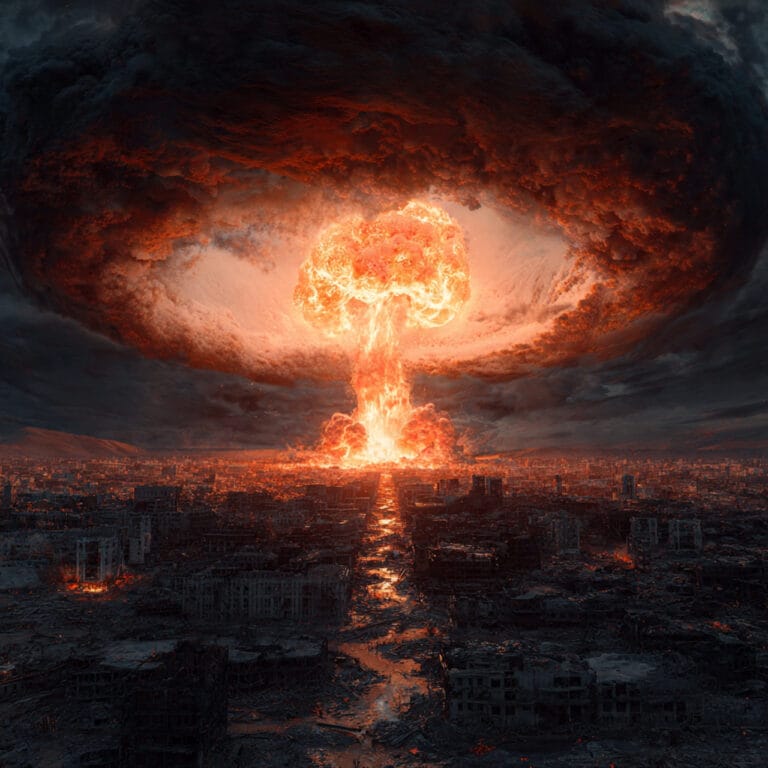

What is Nuclear Famine? It is probably the deadliest consequence of a Nuclear War. When we imagine nuclear war, we picture cities disappearing in seconds. Entire populations vaporized instantly. The blinding flash of a thousand suns and the iconic mushroom cloud. We envision a world ending in fire.
But for the survivors of the initial blast, the fire is just the prologue.
The true catastrophe of nuclear weapons isn’t what they destroy with heat; it is what they destroy with shadow. A slow, silent, and relentless phenomenon that unfolds over a decade. It doesn’t arrive with a bang—but with an empty plate.
This is the reality of Nuclear Famine.
Key Takeaways: The 2026 Nuclear Famine Report
Key findings from our investigation into the secondary effects of nuclear conflict:
- • The 15x Lethality Rule: For every person killed instantly by a nuclear blast, up to 15 others will likely die from global famine.
- • The Atmospheric Shadow: Firestorms would pump over 150 million tons of soot into the stratosphere, blocking sunlight for a decade.
- • The Big Freeze: Global temperatures would plummet by an average of 10°C (18°F)—colder than the peak of the last Ice Age.
- • Agricultural Collapse: Within two years, global production of wheat, corn, and rice would drop by over 90%.
- • Human Cost: A full-scale nuclear conflict is projected to lead to the starvation of 5 billion people.
Aftermath of Nuclear War: Death by Fire vs Death by Hunger

A nuclear explosion kills instantly. People close to the blast are vaporized. Others die from burns, radiation, and collapsing buildings. These deaths are horrific, but they are fast.
Ironically, they may be the lucky ones.
Those who survive face something worse — a world where food systems collapse, sunlight disappears, and survival becomes a daily struggle against starvation.
According to a 2022 study published in Nature Food, the “indirect” effects of nuclear war—primarily the collapse of food systems—would be roughly fifteen times more lethal than the explosions themselves.
Read -> ⚠️9 Warning Signs We Are Closer Than Ever To A Nuclear War?
Why Nuclear War Does Not End With Bombs?
The mechanism of nuclear famine is rooted in the “Firestorm Effect.” When a nuclear weapon detonates over a modern city, it creates a “super-fire” that consumes everything from asphalt to plastics.
Soot Injection
These firestorms act as massive pumps, injecting between 5 million to 150 million tons of black carbon soot directly into the stratosphere.
The Great Dark
Unlike common smoke, this soot rises above the clouds. It cannot be rained out. It stays there for 10 to 15 years, circling the globe and absorbing 70% of incoming sunlight.
The Big Freeze
Deprived of solar energy, global temperatures don’t just “dip”—they plummet. In a full-scale exchange, the Earth’s average temperature would drop by over 10°C (18°F). This is colder than the peak of the last Ice Age.
What follows is a “Nuclear Winter” where the growing season in the Northern Hemisphere—the world’s breadbasket—is effectively reduced to zero.
How Many People Would Die of Nuclear War?
Recent climate-crop modeling (conducted by researchers at Rutgers and NCAR) provides a terrifying hierarchy of outcomes:
The Full-Scale Exchange (e.g., US vs. Russia)
With 150 million tons of soot, sunlight drops by 70%. Wheat, corn, and rice production would collapse by 90% within two years. The projected death toll? 5 billion people. In this scenario, over 60% of the human race dies not from radiation, but from a total absence of food.
The “Limited” Exchange (e.g., India vs. Pakistan)
A conflict using less than 3% of the world’s nuclear arsenal would ignite firestorms, injecting 5 million tons of soot. This would cause a 13% drop in global caloric production. The result? 2 billion people dead from starvation.
What Life Would Look Like for Survivors? Surviving Nuclear Famine
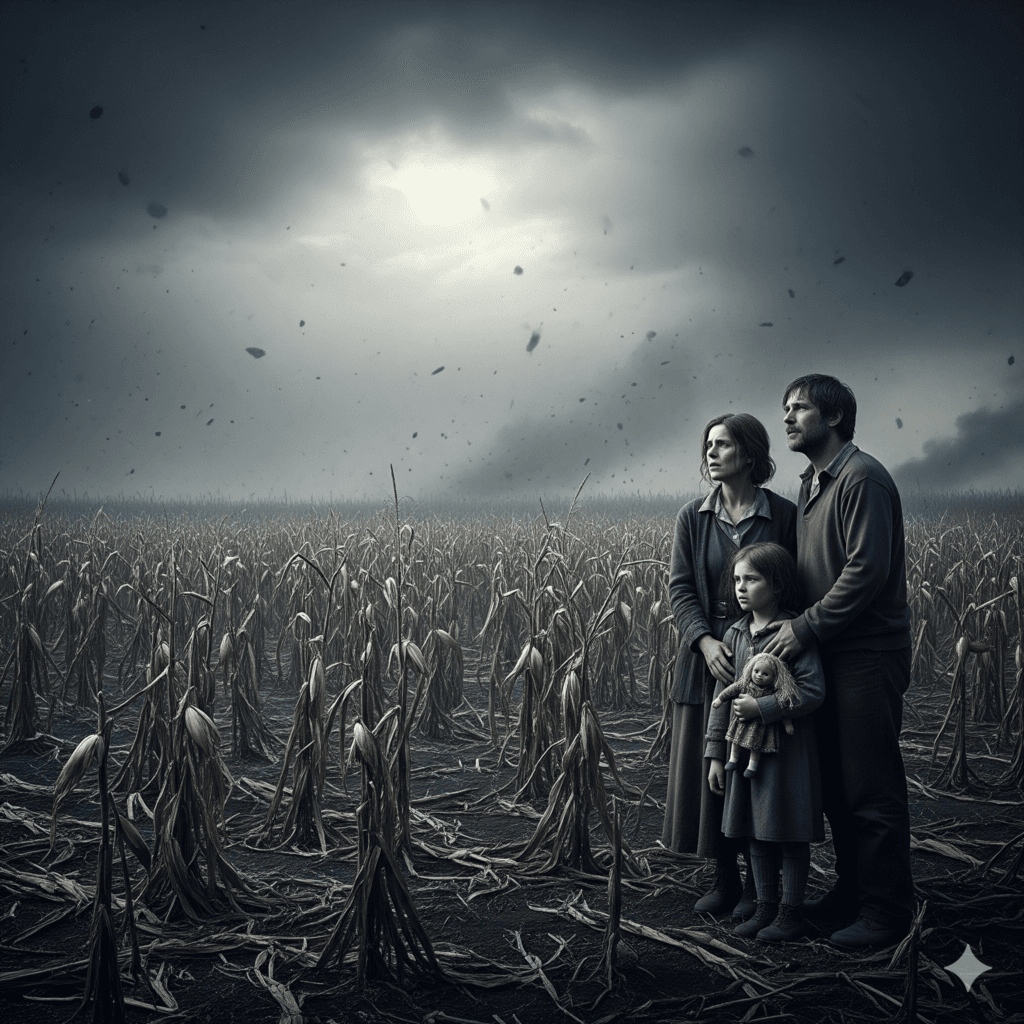
For those left behind, life becomes an exercise in “Malthusian Brutality.”
The Urban Collapse
Cities are “just-in-time” environments. Most major metropolises have only 3 to 5 days of food buffered in their supply chains. When the trucks stop, the city becomes a tomb.
Caloric Protectionism
Nations that can still produce food (like Australia or Argentina) would immediately halt exports to save their own populations. Global trade—the lifeblood of the 21st century—would vanish overnight.
The Migration Crisis
As the “Death Zone” expands across the Northern Hemisphere, billions would attempt to migrate toward the equator. History suggests this will lead to a collapse of borders and a permanent state of resource warfare.
Survival in this era would not be heroic. It would be a desperate, unequal struggle where food becomes the only currency.
Visualizing Nuclear Famine
The infographic below breaks down how nuclear famine unfolds — step by step — from explosions to soot, cooling, crop collapse, and human starvation.
It shows why nuclear famine is not speculation, but a scientifically modeled outcome of nuclear war.
Nuclear Famine
2026 Research Report by anancy.in
The Invisible Aftermath: How smoke, soot, and cold could kill 60% of humanity.
1. The Secondary Catastrophe
While the immediate blast of a nuclear war captures our imagination, the “indirect” effects are far deadlier. Recent modeling suggests that a regional conflict could kill 100 million instantly, but the resulting famine would claim 2 billion lives.
Regional War
2 Billion
Projected Deaths via Famine
Full-Scale War
5 Billion
Projected Deaths via Famine
2. The Smoke Veil
The engine of famine is black carbon soot. Firestorms inject this into the stratosphere, where it persists for over a decade.
3. The Big Freeze
4. Agricultural Zero Hour
In a full-scale scenario, core staple crops face near-total failure as summer frosts kill plants before harvest.
5. Caloric Availability Forecast
Conclusion: The Real Horror of Nuclear Famine
Nuclear war is often discussed in terms of weapons, strategy, and deterrence. But Nuclear Famine is the real deal.
Rarely is it discussed in terms of food. But hunger is what would kill most survivors. Not instantly. Not dramatically. Slowly, relentlessly, and everywhere at once.
Nuclear famine reminds us of a simple truth: Nuclear war does not end civilization with fire. It ends with silence — empty fields, dark skies, and a world that cannot feed itself.
Preventing nuclear war is not just about avoiding explosions. It is about preventing a global famine unlike anything humanity has ever faced.
Disclaimer:
This article analyzes current geopolitical trends and does not predict or advocate conflict. It aims to explain why global risk perceptions are changing.
Reference: Nature